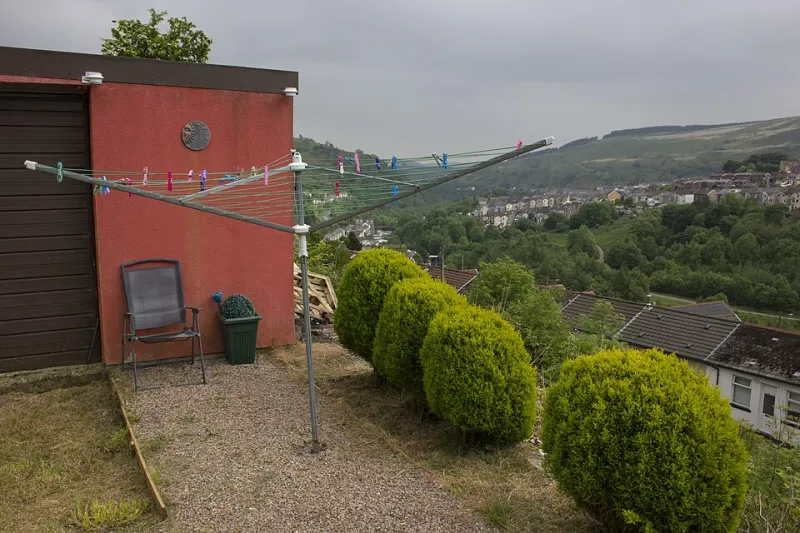
The Pegging Space: Giving Laundry a Place in a Small Wirral Garden
A washing line can feel like the enemy of a beautifully designed small garden. Here’s how to site, screen and soften one so it earns its keep without taking over the view.

Planting, small spaces and outdoor rooms for Wirral homes.
A washing line can feel like the enemy of a beautifully designed small garden. Here’s how to site, screen and soften one so it earns its keep without taking over the view.

Most water butts are bought in a hurry and parked behind a shed. A better approach is to design the whole wet route — roof, pipe, store, overflow and planting — so rain capture looks deliberate and earns its space through a Wirral winter.
A sloping Wirral garden can feel like a problem to flatten, but the fall is often the most useful thing about it. This is a practical guide to reading the gradient, choosing one deliberate change in level, and letting planted edges and well-placed steps do the quiet work.
Quiet rarely arrives by accident in a small garden. This is a practical, layer-by-layer guide to mapping where sound enters a Wirral plot, then softening traffic, rail and neighbour noise without turning the space into a fenced-in box.
Every Wirral garden has a strip that ignores the weather forecast—the narrow band beneath eaves, walls and fences where rain rarely lands. Here's how to read that dry microclimate, improve the soil without turning it into a sump, and plant it with tough, handsome species that earn their place.
Bare-root season is the cheapest and calmest moment to put fruit into a small Wirral garden. Here is how to choose a compact rootstock, site a pot out of the wind, sort out pollination and keep the whole thing small enough to live with.
That narrow strip between house and boundary is usually treated as a service corridor. In a small Wirral garden, it can become one of the hardest-working rooms you have — if you plan for shade, wind, drainage and the route from front to back.
Bins, bikes, logs and muddy boots are not a failure of small-garden design — they are the reality of a working home. This is how to give them a proper place on a Wirral plot, with screening that survives the wind, storage that handles the wet, and planting that softens the edges without getting in the way.
A small Wirral garden can greet you long before you see it. This is a practical guide to planting the first metre for scent, using winter performers and clever placement to make a compact plot feel warmer, deeper and more welcoming in November and beyond.
Your plot may only be nine metres deep, but the eye doesn't stop at the fence panel. Here's how to frame the mature trees, rooflines and distant sky beyond your boundary — and how to avoid building the very thing that blocks them.
By mid-November most Wirral gardens have a green carpet nobody planted. Moss is not automatically a fault — but it is not automatically fine either. Here is how to tell which moss is costing you money, which is quietly doing the design work, and what to plant next to it so the whole thing looks chosen rather than neglected.
Cold air behaves like water in a small garden: it drains to the lowest point and sits there. Here’s how to spot the frost pockets in a Wirral plot, test them properly, and soften their effects without turning your garden into a building site.
By half past four on a December afternoon, most small Wirral gardens have already gone dark — and the usual response is a floodlight that ruins the view for everyone. Here's a gentler approach: a few well-placed, low-glare fittings that make the path, the step and one good bit of evergreen legible, without turning your plot into a car park.
Every Wirral garden has one wall that behaves better than the rest — warmer, calmer and worth designing around. Here’s how to find it, plant it, and stop it turning into a dry, sun-baked corner you never use.
Most small Wirral gardens don’t fail on taste. They fail on upkeep. Here’s how to design a plot that looks deliberate—and still holds together after a wet week and a windy weekend—without turning your garden into a second job.
Some pots are decorations. In an exposed Wirral yard, you want the ones that behave like infrastructure. A practical, slightly opinionated guide to heavy containers, free-draining compost and a short list of plants that still look decent in January.
From November onwards, the most important view of a small Wirral garden is often from the kitchen sink or the back bedroom window. This is how to design a plot that works as a living picture through glass, with evergreen bones, winter scent and lighting that flatters rather than glare.
New-build gardens rarely arrive ready to plant. On a Wirral plot you are often working with compacted subsoil, narrow borders, tall fences and wind that finds every gap. This first-year plan puts soil and shelter before shopping lists.
Most Wirral front gardens are treated as leftover space: a bin store, a parking pad, a path to the door. This is a case for giving that strip the same design attention as the back garden, with zoning, shelter and planting that earns its keep in wind and rain.
A small garden can be worth stepping into after work, even when the light is low and the air is cooling. Here's how shelter, warm-toned planting, scent and subtle lighting turn a daytime plot into an evening outdoor room that works beyond high summer.