The Hush Map: Tuning a Small Wirral Garden to What Reaches It
A small garden can look completely right and still feel wrong. Often the problem is not the paving, the planting or the paint colour. It is the sound. Sit down on the bench you actually use and you will hear the things you screen out when you are standing up, busy, and on your way somewhere: the low wash of traffic from the A540, a train on the Wirral Line, a neighbour's extractor fan, a heat pump cycling on, gulls, a distant mower, the bin lorry reversing.
Quiet is a design material. Not silence, obviously. A garden without any sound is a sealed room, and nobody wants that. What most of us want is a lower background, a softer edge and a few minutes when the outside world stops interrupting. In a small Wirral plot, that is rarely achieved by one heroic gesture. It comes from understanding where sound enters, then layering small, sensible moves.
Start by sitting still and taking a sound survey
Before you buy a single panel of trellis, spend a week listening properly. Pick three spots: the back door, the main seating area and the place you would sit if the garden were quieter. Visit each at different times. A weekday morning is not the same as the school run, and a Saturday afternoon is not the same as a Sunday evening. Note what you hear, which direction it comes from, and whether it is constant or occasional.
Draw a simple plan of the garden and mark the loud edges. The M53 may be a distant rumble rather than a roar, but it still shapes the background. A side return beside a semi can funnel next-door's radio straight to your patio. A gap under a fence can let more through than the fence itself. This is your hush map. It is more useful than any generic list of noise-proof plants.
Find the leaks before adding height
Sound is sneaky. It does not respect the tidy line of a boundary. It slips through gaps between fence boards, under gravel boards, through a gate that does not meet its frame and around the end of a hedge. Before you make anything taller, make what you have continuous. A solid gate with a drop seal, an overlapping board, a planted strip at the base of a fence, a piece of gravel board that actually touches the ground: these small fixes can take the edge off a harsh, whistling gap.
In a small garden, height is not always your friend. A two-metre fence can make a plot feel like a corridor, especially in a Merseyside winter when light is already short. Mass and continuity usually matter more than raw height. A lower, dense barrier with no gaps can do more than a tall, flimsy one that rattles in the wind.
Choose barriers with bulk, not just decoration
Hedges work because they are thick, porous and alive. They interrupt sound, hold leaves, and soften the hard geometry of a boundary. Yew, holly, privet and laurel are the usual dense evergreens, but be honest about space. A hedge that is only 30cm deep is more of a gesture than a barrier. Beech and hornbeam keep a cloak of dead leaves through winter and suit many Wirral gardens, though they will not perform miracles against a main road.
A fence plus a hedge is often the most realistic combination in a small plot: the fence provides the solid mass, and the hedge hides it, softens the wind and adds another layer. Do not rely on trellis and a few climbers alone. Climbing plants are lovely, but they are not a substitute for density. If you are replacing a fence, close the boards, brace the posts properly for wind, and check what is allowed under permitted development before you build. In exposed coastal spots around New Brighton or West Kirby, a fence that is not braced will announce itself loudly in every gale.
Soften the ground underfoot
Hard surfaces reflect sound. A large patio, a deck and a wide expanse of concrete will bounce noise around a small garden. Lawns, bark paths, planted beds and mounds of low ground cover break that up. Gravel is interesting because it masks sound with its own crunch, but it can also become the noise you notice most. Use it as a deliberate strip near a gate or beside a less-used path, not as a blanket over the whole plot. A small garden covered in gravel can sound like a crisp packet in a quiet room.
Raised beds and planted mounds also interrupt sightlines and sound paths. They do not need to be tall. A low bank of shrubs between the patio and the boundary can take the hard edge off a reflective wall.
Use water as a gentle mask, not a competitor
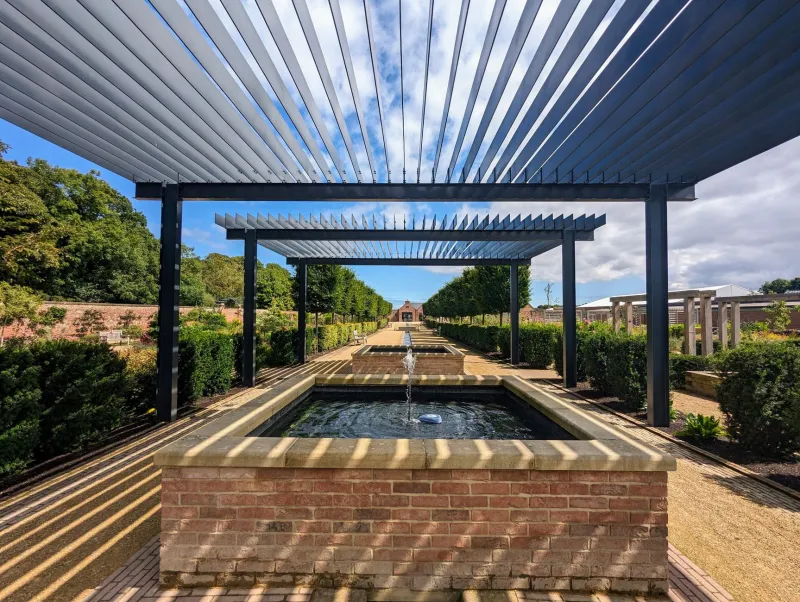
A small water feature is one of the most effective ways to change how a garden feels acoustically. The trick is to place it close to where you sit, so the sound is near your ear, rather than at the far boundary where the wind will carry it away. A low, steady trickle or a small pebble pool can blur traffic and neighbour noise without making you raise your voice.
Be realistic about maintenance. Pumps need power, cleaning and winter thought. In a windy Wirral garden, water can spray where you do not want it and the sound can be blown off course. Keep the feature sheltered by planting, make the pump accessible, and do not make it so loud that it becomes its own nuisance. The aim is a soft wash of sound, not a fountain that sounds like a leaking radiator.
Plant for rustle and occlusion
Leaves and stems do two jobs: they block sightlines and they add a gentle, natural sound that distracts the ear. Evergreen structure gives you year-round bulk, while deciduous plants add movement and rustle in summer. Ornamental grasses are excellent in a small garden because they move in the slightest breeze, softening the hard lines of a fence and masking high-frequency noise. Miscanthus, deschampsia and stipa all earn their place, though they need sun and decent drainage.
If you are tempted by bamboo, choose a clumping variety or use a root barrier. Running bamboo in a small Wirral garden is a long-term argument you will not win. Dense shrubs at the boundary, repeated along the loudest edge, will do more than a scattered collection of pretty plants.
Move the seat before you rebuild the garden
The most overlooked acoustic move is also the cheapest. Most of us push the bench against the house wall or the back fence. Both can be bad choices. A wall reflects sound back at you, and a boundary may be exactly where the noise enters. Try pulling the seat forward, angling it away from the loudest corner, and putting planting behind you. A bench with a high back and a few soft cushions will absorb a little sound and make the spot feel more enclosed.
A pergola with climbing plants overhead can also take the edge off a space, though it will not stop traffic. The point is to create a small pocket where the sound is quieter, not to seal the garden. Sometimes moving the seat two metres and adding a water bowl is more effective than a whole new fence.
Layer, then stop
A quieter small garden usually has three layers: a continuous boundary with some mass, a planted buffer that softens and obscures, and a masking sound close to the seating. That might be a thickened hedge, a repaired gate, a gravel path and a small fountain. It does not need to be expensive, and it certainly does not need to turn the plot into a dark box.
After you make changes, sit down again and redraw your hush map. Some noise will remain. A small garden near a road or railway will never be silent, and pretending otherwise leads to overbuilding. The goal is a lower background, a softer edge and a seat that feels worth staying in. In a Wirral garden, that is usually achieved by listening first, fixing the leaks, and then adding just enough to let the quiet through.