The Slope You Keep: Designing a Wirral Garden That Falls Away
Most sloping gardens in Wirral are not dramatic. They rarely tumble away like a fellside. They lean. The lawn drops a little from the back door, the patio sits proud of the border, and by the time you reach the bottom fence you are standing perhaps half a metre lower than where you started. It is enough to make a bench feel awkward, enough to send rainwater towards the shed, and enough to tempt anyone into a patchwork of little terraces that never quite meet.
The better move is usually to keep the slope and give it a job. A garden that falls away from the house can feel open, borrowed and quietly dynamic. It can drain. It can frame a view. It can make a small plot feel larger because the ground itself is doing something. What it needs is not a fight, but a clear decision about where the level changes and why.
Read the Fall Before You Draw Anything
Start by walking the garden after rain. Not a drizzle, but proper Wirral rain, the sort that arrives sideways and then settles. Note where water lingers, where it runs, and where the ground stays spongy for a day longer than it should. Those wet patches tell you more about the fall than a spirit level alone.
Then use a simple string line or a long straight edge to find the direction of the slope. Is it falling directly away from the house, or across the plot? Does it drop steadily, or is there a shelf halfway down where the ground flattens? In smaller gardens, the fall is often diagonal, which is why a single rectangular terrace can feel wrong. The garden is moving one way; the paving is moving another.
You do not need a survey to make this useful. You need to know the high point, the low point, and the line between them. That is your fall line. Once you can see it, you can decide whether to work along it, across it, or let it carry water to a planted hollow at the bottom.
One Change of Level Is Usually Enough
A small garden rarely benefits from three terraces. Each additional level eats space, adds a retaining edge, and creates another place for steps to look bolted on. The result can feel like a staircase with shrubs.
Aim for one meaningful change in level. That might be a generous terrace directly outside the back door, deep enough for a table and two chairs, with the rest of the garden left to slope gently away. Or it might be a raised seating area at the far end, lifted just enough to catch the last of the evening light over a fence. The key is that the level change has a purpose: sitting, eating, looking, or simply separating the busy part of the garden from the quieter part.
Make that one level generous. A shallow terrace that is barely deep enough for a chair will feel mean, no matter how neatly it is built. In a small Wirral plot, it is often better to take a bigger bite out of the slope in one place than to nibble at it everywhere.
Let the Edge Do the Work
Where the ground steps up or down, the retaining edge is not just structure. It is part of the garden. A visible concrete wall can look like a repair. A planted edge can look like the slope has simply been persuaded into a better shape.
Low retaining walls, perhaps two or three courses of brick or a single timber sleeper, can be softened with ferns, heuchera, trailing rosemary or low grasses. If the drop is taller, get proper advice: retaining walls hold soil and water, and a tall wall in a wet garden is not a DIY experiment. But in many small Wirral gardens the change is modest, and the edge can be kept low and planted.
A planted bank is another option. Instead of a hard wall, let the soil slope more gently and cover it with robust ground cover. Alchemilla, hardy geraniums, vinca and shade-tolerant grasses can knit the levels together. On a sunny slope, thyme, oregano and low sedums will cope with the free-draining top edge. At the bottom, where water collects, choose plants that do not sulk in damp: sedges, astilbe, moisture-loving ferns and cornus for winter stems.
Steps That Feel Like Garden, Not Staircase
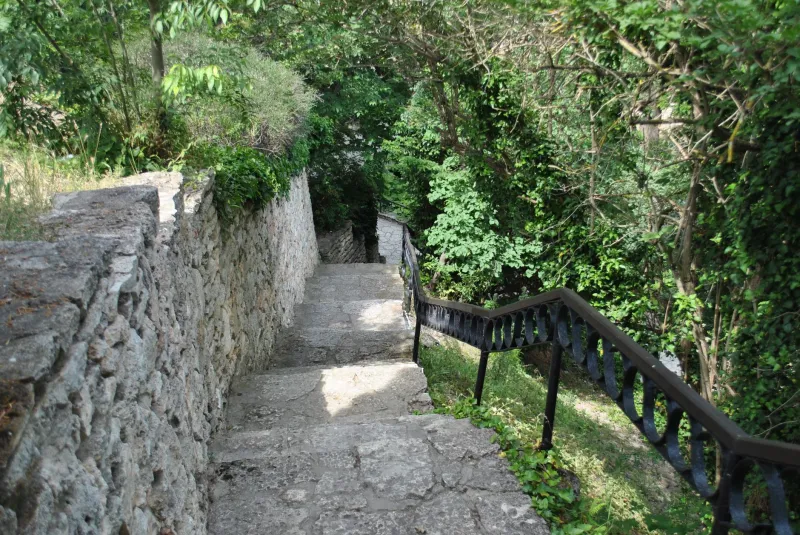
Steps are where sloping gardens most often go wrong. Narrow steps with tight risers feel like a fire escape. Wide steps with a landing feel like an invitation.
Keep the steps generous. A width of at least a metre is comfortable, and wider still if the steps are also a route to the compost bin or shed. Use the same paving as the terrace, or a material that relates to it, so the steps read as part of the ground rather than an added object. A gentle riser and a deeper tread are kinder underfoot, especially in wet weather.
Think about where the steps land. If they tip you straight into a border or a fence, they will always feel awkward. Give them a small landing, a change of surface, or a planted pocket at the bottom. Even a single pot or a low mound of grasses can make the bottom step feel intentional.
Plant for Water That Moves
A slope is a drainage system, whether you plan for it or not. Water will run along the fall line and gather at the lowest point. That is not a flaw, but it does shape what you plant.
Use the top of the slope for plants that tolerate drying out, and the bottom for plants that don't mind a drink. Mulch bare soil to stop winter rain washing it away. Avoid a tightly mown lawn on a steep slope; it is difficult to maintain and does little to slow water. A loose drift of grasses, hardy perennials and low shrubs will hold the ground better and look more relaxed.
Make the Fall Feel Deliberate
A sloping garden does not need to be flattened into submission. It needs one clear level change, an edge that is planted rather than merely built, and steps that feel like they belong. Get those three things right and the gradient stops being an inconvenience. It becomes the shape of the garden, the reason the view opens up, and the quiet move that makes a small Wirral plot feel considered.