The Pegging Space: Giving Laundry a Place in a Small Wirral Garden
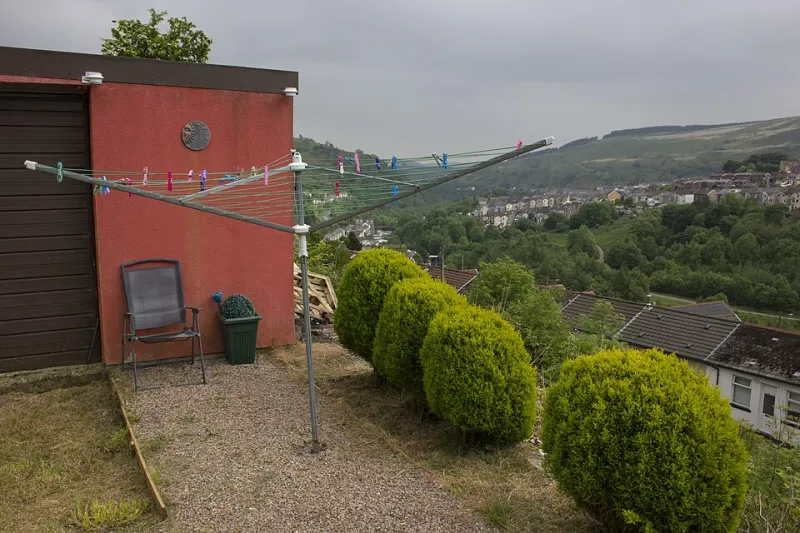
Photo: Jeremy Segrott from Cardiff, Wales, UK, CC BY 2.0, via Wikimedia Commons
Laundry is the unglamorous room-mate of garden design. It turns up without being invited, takes up more space than you planned, and leaves the place looking lived-in. In a small Wirral garden, where every metre has to work harder than it should, the washing line can feel like the one thing standing between you and the calm outdoor room you had in mind.
But pretending it isn’t there rarely works. In 2026, with outdoor drying still the most sensible way to avoid paying for heat you don’t need, the line deserves a proper place in the plan. Not hidden away in shame. Not dominating the best view either. The trick is to design a pegging space — a small, deliberate working zone that can be put away, screened or simply softened when the washing is in.
Start with an honest map of the plot
Before choosing a rotary dryer or a retractable line, spend ten minutes outside with a pencil. Mark where the sun actually lands through the day, where the wind funnels between buildings, and where you naturally walk. In Wirral, that last point matters as much as the first two. A line strung across the main path from back door to shed will be resented by everyone in the house, especially on a wet Monday.
Think about the view from the kitchen window too. If the best sightline ends at the rotary dryer, you will notice it every day. If it ends at a border, a pot or a bit of fence with something scrambling over it, the laundry becomes background noise. Same dryer, different relationship.
Wind, rain and the Wirral reality
A Wirral garden can be sunny at the front and breezy enough at the back to turn a bedsheet into a sail. Coastal gardens near West Kirby and Hoylake get the salt-laden version; inland plots in Bebington or Birkenhead often get a choppier, gustier draught between houses. Either way, an exposed rotary dryer on a windy day is not a drying system — it’s a wrestling match.
Site the line where it catches moving air but not the full force of it. A spot behind a shed, hedge or fence can dry washing surprisingly well while sparing you the airborne peg routine. If wind is a real problem, a retractable line across a sheltered corner may be more useful than a big rotary out in the open. And in a small plot, a rotary with a decent cover can earn its place in spring and autumn, when showers arrive without warning.
The ground beneath the pegs
This is where many small gardens quietly fail. A rotary dryer on soft grass sounds fine until February, when the lawn turns into a mud patch and every peg run leaves a trail of footprints. A line over a gravel border can be worse: small stones travel indoors, and the surface ruts under repeated traffic.
Choose a firm, forgiving surface for the working zone. Compacted gravel with a binding layer, paving, or a short stretch of reinforced grass can all work. A simple path of stepping stones from the back door to the line is often enough, provided the stones are wide enough to land on without thinking. If the dryer sits on grass, consider a hard-standing pad or a small square of paving beneath it. It won’t win design awards, but it will stop the pegging space becoming the messiest corner of the garden.
Screening that doesn’t sulk
Screening is the obvious answer to an ugly dryer, but a solid panel in the wrong place can turn a small garden into a wind tunnel or a dark box. In Wirral’s damp air, close-board fencing can also become a green slipcover within a season if it is tucked into a shady corner with no airflow.
Slatted screens, hit-and-miss fencing or a simple reed roll allow air through while breaking up the view. They are lighter on a small plot and less likely to create a dead, mossy strip behind them. If you want a living screen, choose something that tolerates clipping and doesn’t mind a bit of shade. A low hedge or a run of tall grasses in front of the line can blur the working edge without blocking light.
Planting for the peg-line shuffle
The ground around a washing line takes a peculiar kind of traffic. It isn’t a path and it isn’t a border. It’s a shuffle zone: feet in odd places, baskets set down, sheets dragged past. Plants here need to be tough, forgiving and reasonably upright.
Good candidates include robust grasses such as pheasant’s tail or fountain grass, low shrubs that can take a bit of brushing past, and perennials that don’t collapse the moment a towel lands on them. Avoid anything precious or spiky right beside the line. Lavender works near a sunny, sheltered edge, but it sulks in wet shade and hates being trampled. If the pegging space is shady, go for shade-tolerant structure instead: ferns, epimedium, or a simple clipped box or yew in a pot.
The aim is not to dress the dryer in flowers. It is to make the surrounding planting robust enough that the working zone doesn’t look battered by August.
A 2026 note on drying outdoors
Outdoor drying has had a quiet resurgence in recent years, partly because it saves energy and partly because people have realised that a garden can be useful as well as pretty. In 2026, the small-garden challenge is not whether to dry outside — it is how to do it without sacrificing the bit of outdoor space that makes the house feel bigger.
The answer is usually a compromise, not a grand gesture. A retractable line that disappears into a wall-mounted housing. A rotary in a corner with a paved pad under it. A slim airer that lives behind a slatted screen and comes out on dry days. None of these are glamorous, but they are honest. They acknowledge that a Wirral garden is a working space as well as a viewing space.
The compromise that works
A well-designed pegging space does not hide laundry away as if it were shameful. It gives it a place, a surface and a bit of screening, then lets the garden get on with other things. You will still see washing on the line. That is the point. But you will also see the border, the view and the reason you stepped outside in the first place.
In a small Wirral plot, that balance is worth designing for. The line can stay. It just needs to know where it belongs.