A Garden for the Weather You Get: Short Dry Windows in Small Wirral Plots
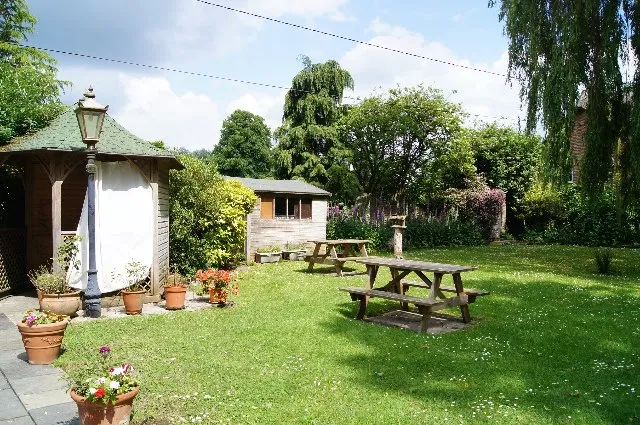
Photo: ad acta , CC BY-SA 2.0, via Wikimedia Commons
There is a particular moment in a Wirral garden when the rain stops, the gutter keeps dripping for another minute, and the sky looks briefly undecided. You have maybe ten minutes before the next band comes in off the Irish Sea. The question is whether the garden is ready for that ten minutes, or whether it is still designed for a long, dry evening that never quite arrives.
A lot of outdoor-room advice is built around the imaginary perfect afternoon. The pizza oven is lit, the cushions are out, the sun is going down slowly over a fence in Heswall. In reality, many small Wirral plots get used in short slices: a cup of tea between showers, a quick deadhead, a sweep of the path, a minute standing under the doorframe deciding whether to risk it. Designing for those slices is not a compromise. It is just more honest about the weather.
Design for the gap, not the gala
The useful question is not “what would this garden be like on its best day?” It is “what can I do here in the time I actually get?” That changes the priorities. A bench you can reach in five seconds matters more than a seating area at the far end of the lawn. A path that drains matters more than a perfect lawn edge. A pot of rosemary by the door matters more than a border you admire from a distance but never touch.
This is especially true in small gardens. On a big plot, you can afford a soggy bottom corner and a long walk to the shed. On a compact yard in Wallasey or a narrow strip behind a terraced house in Birkenhead, every metre has to earn its place. If the dry window is short, the garden needs to be quick to enter, quick to use, and quick to leave without turning into a mud bath.
Put the seat where the rain stops first
Shelter is the first move. Not a full outdoor room, necessarily, but a dry pocket. In most Wirral gardens, the leeward side of the house or a solid wall is calmer than the open end of the plot. A fence or hedge helps, but it needs to be the right fence or hedge in the right place. A bench tucked against a south-facing house wall, with a bit of cover overhead and a hard surface underfoot, will get used far more often than a prettier bench marooned on the lawn.
Think about the route to it. If you have to cross wet grass to reach the seat, you will not bother. If the bench is two steps from the back door and the paving is clear, you will. That is the difference between a garden feature and a garden habit.
It also helps to accept that the best spot may not be the most picturesque one. The corner with the best view might also be the windiest. The sunniest seat might be the one that catches every shower running off the roof. In a small garden, comfort beats composition more often than garden magazines admit.
Surfaces that forgive a shower
Fast-draining surfaces are not just a hard-landscaping detail. They are what make a ten-minute window usable. Gravel, permeable paving, clay pavers laid with gaps, stepping stones set into grit, or decking with proper gaps and a bit of fall all cope better with a shower than a flat sheet of impermeable paving with nowhere to send the water.
The key is to avoid the puddle that sits exactly where you want to stand. That usually means thinking about fall and drainage before choosing the finish. A gentle cross-fall away from the house, a channel or gravel trap at the low edge, and a clear route to the bench will do more for the garden than a fancy paving pattern. It is not glamorous, but it is the sort of thing you notice every time you step outside in November.
Keep a stiff broom and a watering can near the door, too. A ten-minute dry spell is often long enough to sweep the path, clear a drain gullies, or move a few pots — small jobs that stop the garden sliding into neglect between proper gardening days.
Scent and touch within arm’s reach
Plants near the door should earn their place by being touchable, sniffable or useful. Rosemary, thyme, lavender, winter honeysuckle, sarcococca and daphne all give something back when you brush past them, and many cope with Wirral’s wind and wet. A pot of mint by the step is worth more than a border of delicate things you never get close to. Scented pelargoniums work in summer; in winter, a small mahonia or a winter box gives you something to lean in for.
This is not about cramming every plant into the threshold. It is about placing a few good ones where the dry window happens. Wet foliage after rain can be just as fragrant as a flower, especially on rosemary or lavender. The garden should smell like something when you open the door, even if you are only out there long enough to pick a few herbs and come back in.
Two jobs, not a list
A ten-minute dry spell is not the time for a full border overhaul. It is the time for one or two small jobs that leave the garden slightly better than it was. Deadheading, sweeping, picking herbs, checking pots, filling the bird feeder, tying in a climber, pulling a few weeds from the path edge. These are the jobs that keep a small garden legible.
The trick is to make them easy to start. Keep secateurs, a trowel and a pair of gloves in a waterproof box by the door. If the tools are in the shed at the bottom of the garden, the window will close before you get there. A small garden should be designed so that the first useful job is never more than a few steps away.
The honest version of an outdoor room
None of this means giving up on beauty. It means letting the weather set the brief. A sheltered bench, a free-draining path, a pot of something fragrant and a couple of jobs within reach — that is a real outdoor room in Wirral. It will not look like the styled photographs, and it will not survive every downpour. But it will be there for the gaps, which is when most of us actually garden.
The rain will come back. It always does. The point is to make the garden worth opening the door for in the meantime.