Look Through, Not At: Boundary Planting That Stretches a Small Wirral Garden
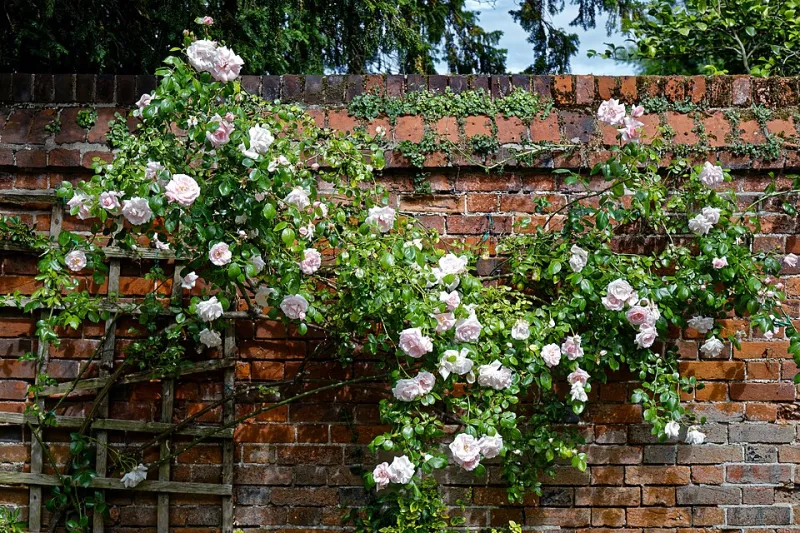
Photo: Acabashi, CC BY-SA 4.0, via Wikimedia Commons
There's a particular moment in a small garden when the fence stops being a boundary and starts being a wall. You notice it in February, when the border is bare, and the panels are the only thing to look at. Six feet of featheredge, all the way round, and a plot that suddenly feels like a box.
The instinct is to plant it up thickly — to hide it. And that's exactly the move that keeps a small garden small. Solid green all the way round gives the eye nowhere to travel, so it stops at the edge and comes straight back. The trick is the opposite: give it somewhere to go.
Garden designers call it borrowed landscape, which sounds grander than it is. It simply means using what's already there — a mature oak two doors down, a church spire, the hills across the Dee, even the roofline of a neighbour's Victorian semi — as though it belonged to your plot. In a Wirral garden, with sea on three sides and hills inland, there's usually more out there than we give ourselves credit for.
Find the view before you choose the plants
Walk the garden at different times of day and note what's worth keeping. From Hoylake and Meols the light off the water is the thing. From Heswall and lower Caldy you may have the Welsh hills; from parts of Oxton and Prenton, a treetop canopy that reads as woodland if you never see the trunks. Even an unpromising view — a roofline, a line of mature limes along a back alley — can work if you frame it properly.
Framing is the whole craft. Two upright evergreens, 2–3 metres apart, with clear air between them, will direct the eye out through the gap far more effectively than a low wall ever could. The boundary becomes a series of openings rather than a lid.
Change the top of the fence, not the whole thing
You don't need to replace good fencing. Take the top 30–45cm off a panel or two and replace it with a trellis, a rail-topped section, or a hit-and-miss slat screen. Sightlines open up, the garden still feels enclosed at sitting height, and the effect is surprisingly generous — a metre of borrowed tree canopy above a fence does more work than a metre of extra lawn.
Where privacy matters — beside a neighbour's kitchen window, say — keep panels solid and put the see-through section somewhere else. The point isn't transparency everywhere; it's that at least one part of the boundary lets the eye escape.
Screen the things that need screening, and only those
Every small Wirral garden has something to hide: a bin store, a rotary line, a trampoline, a garage wall in bad render. The mistake is treating the whole boundary as camouflage.
Pick your targets. A single upright evergreen — Pittosporum tenuifolium, Olearia macrodonta, or a carefully sited Phormium — will do more than a hedge running the full length. Then leave the rest of the boundary loose and layered, so the good views stay open.
Plants that cope with Wirral's wind and salt
This is the part that trips people up, because the loveliest airy evergreens are often the tenderest. A few that genuinely earn their place on a windy peninsula:
- Griselinia littoralis — excellent salt tolerance and that soft apple-green leaf, though it wants a sheltered spot inland and resents cold, exposed sites. Trim it lightly; hard cutting back into old wood is a gamble.
- Escallonia — glossy, fast, and happy near the coast. 'Apple Blossom' gives pink through summer and takes shearing well if you want a low, open hedge.
- Olearia macrodonta — holly-leaved and tough, with grey-green undersides that catch the light. Tight clipping makes it boxy; let it breathe.
- Euonymus japonicus — reliable where the wind funnels between houses, and there are variegated forms that lift a dark corner.
- Tamarix and Hippophae rhamnoides for the most exposed, sand-influenced gardens, though both want room to sprawl.
For structure rather than screening, a multi-stem Amelanchier lamarckii or a Sorbus will carry a garden through four seasons without ever becoming a wall, and both tolerate Wirral's damp winters far better than their delicate appearance suggests.
Inland, away from the salt — Bebington, Bromborough, Thingwall — you can be braver: Myrtus communis, Pittosporum 'Silver Queen', Ceanothus against a warm wall.
Layer it, and repeat it
A boundary that reads well has three depths: something tall and open at the back, a mid-layer of shrubs that don't quite meet, and low planting that spills forward. Gaps between the mid-layer are the point — they let you see through to the borrowed view and back again.
Then repeat one plant along the length. A single rhythm of, say, Carex or Anemanthele lessoniana running the boundary ties the layers together and stops the eye snagging on individual plants.
The practical bit
Check before you prune or plant: hedges over two metres can fall under high-hedge rules, and anything you dig needs to be clear of drains and service pipes. If a boundary tree is causing a dispute, talk to your neighbour long before you reach for a saw — and if you're planting for screening, remember a slow-growing evergreen is usually a better long-term neighbour than a fast one that needs annual surgery.
Given the salt, rinse evergreens after a battering easterly, mulch to keep roots steady, and stake anything tall for its first two winters. Then leave it loose. A boundary that lets the view through will make a small garden feel like it goes on for miles.